
Employee absenteeism is not a homogeneous phenomenon. In the literature of the subject, several of its types are distinguished. Natural absenteeism is due to real health reasons or other justified circumstances preventing the performance of the work. Organizational absenteeism (gray) On the other hand, it is associated with improper management of processes in the organization, inefficient organization of work or lack of preventive measures. In turn pathological absenteeism means abusing sick leave or using it inappropriately in order to avoid professional duties.
Such a distinction allows you to better understand the essence of sick leave. Although the direct cause is the health of the employee, the risk of illness and the length of absence can also be influenced by working conditions. Chronic stress, overload with responsibilities, an unfavorable organizational climate, improper ergonomics of the position or an imbalance between work and private life increase the risk of health problems and consequently lead to more frequent sick leave. This means that the health of employees is not only their individual responsibility, but an important element of the modern approach to occupational safety, health and well-being (wellness) in the organization.
Sick leave also has tangible consequences for employers. Sudden absences hinder work planning, increase the burden on other employees, can affect the timeliness of tasks and generate additional costs related to the organization of replacements. Therefore, more and more organizations are monitoring the level of absenteeism and analyzing its causes. A helpful tool is National Sick Absence Index, which — as Prawo.pl points out — is the only one in Poland that allows calculating absenteeism rates for a specific company based on the source data provided by it. This allows you to compare the results of the organization with other enterprises and better plan preventive actions. (Prawo.pl)
In Poland, the rate of sick leave is growing and the 3 most common cause is mental health
According to the ZUS report “Sick leave in 2025", the number of sick leave in Poland continues to remain at a high level. In 2025, 27.5 million medical certificates were issued covering a total of 290.5 million days of sick leave, a slight increase compared to the previous year. Significantly, the third most common cause of absenteeism was mental disorders and behavioral disorders, accounting for 14.1% of all sick leave days.
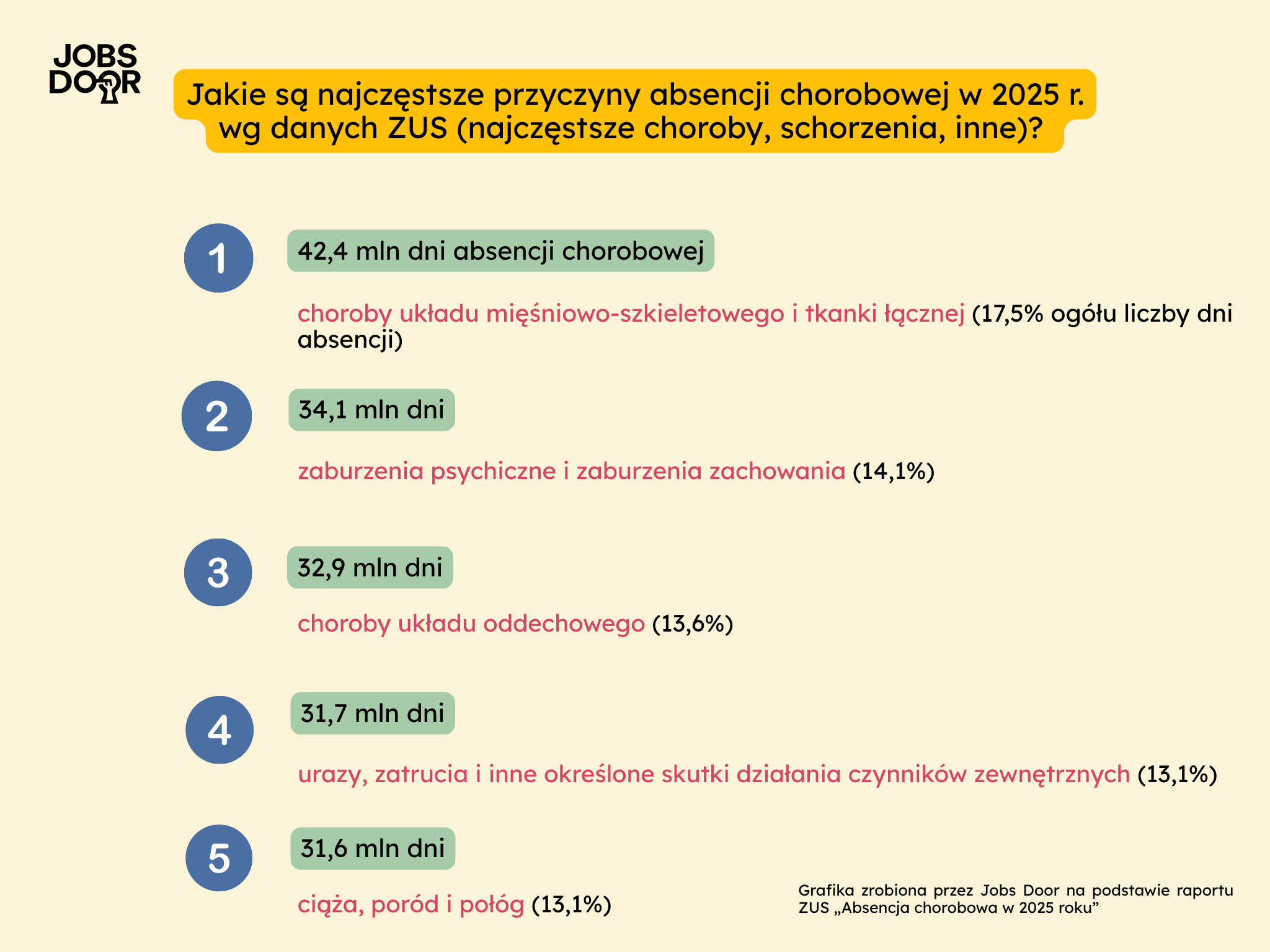
According to the ZUS report “Sick absence in 2025”, mental disorders and behavioral disorders were the second most common cause of sick leave in Poland in terms of the number of days of absence from work. They accounted for 34.1 million days of absence, or 14.1% of all sick leave days.
The increasing share of mental disorders among the causes of sick leave shows that the state of mental health of workers should become one of the priorities of measures for occupational safety and health. According to the ZUS report for 2025, mental disorders and behavioral disorders were the second most common cause of sick leave in Poland, accounting for 14.1% of all days absent from work. At the same time, CBOS research shows that 27% of Poles aged 18—44 have already used the help of a psychologist, psychotherapist or psychiatrist, which shows a growing awareness and scale of mental health needs.
Despite this, many organizations still have a work culture that is not conducive to talking openly about mental problems or safely returning to full balance after a health crisis. For employers, investing in a friendly, dignified and safe working environment is not just an expression of concern for employees. It is also an action that can reduce sick leave, support team engagement, improve productivity and strengthen the long-term effectiveness of the organization.
Recommendations
The effective reduction of sick leave should be based primarily on preventive measures. Building employee engagement, strengthening the relationship between management and the team, and conducting well-thought-out recruitment processes help create a work environment that reduces the risk of absenteeism and supports employee well-being. Educational and organizational activities are also an important element. Training in occupational safety and health, health promotion or ergonomics helps to reduce the risk of illness and injury, and appropriately designed incentive systems and transparent remuneration rules can reduce the abuse of sick leave and strengthen the sense of responsibility for the organization.
It is also worth using the experience of other companies and regularly analyzing your own absenteeism rates. The exchange of good practices, monitoring the causes of absences and investing in the development of managerial competencies allow for more effective planning of preventive measures. In the long term, this approach not only translates into a reduction in sick leave, but also in higher employee involvement, greater efficiency of teams and better results of the entire organization.
Sources:
- https://www.prawo.pl/kadry/absencja-chorobowa,266669.html
- https://www.zus.pl/documents/10182/12108079/Absencja_I_XII_2025.pdf/06819835-6be8-96ab-b90f-2ccaa4a6639a?t=1769065276284


 Polski (PL)
 English (EN)
 Español (ES)
 العربية (AR)
 Українська (UA)