
Today, Poland is becoming an increasingly diverse country in society. In 2022, due to the escalation of the war in Ukraine, as many as 8.8 million people from Ukraine crossed the Polish-Ukrainian border. According to current data, about 1.8-1.9 million Polish citizens remained permanently in Poland. Four years after the outbreak of a full-scale war with Russia, the social landscape, the culture of two neighboring nations and the functioning of the labor market have changed. We also have more and more data on how the Ukrainian community finds itself in Poland and how its presence affects the Polish economy.
Despite more and more frequent extreme narratives about the allegedly negative impact of the presence of people from Ukraine on the Polish economic situation, the data from the latest research show a different picture. Both the professional activity of Ukrainians and their contribution to the insurance system indicate that the presence of immigrants from a neighboring country affected by the war not only does not have to destabilize the Polish economy, but in some areas it can support its functioning. Thanks to the latest report prepared by Deloitte, which analyzes the impact of refugees from Ukraine on the Polish economy, we can take a closer look at issues such as earnings, insurance, occupations and professional activity — all based on data, not arguments drawn from random observations.
Who are Ukrainians in Poland?
The population of people from Ukraine is concentrated primarily in large urban centers, where access to work is greater and more diverse, a wider network of contacts is possible (family, friends, other people from the Ukrainian community), as well as better access to infrastructure and differentiated services (public transport, schools, integration assistance and offices).
From the data presented in the Deloitte report Poland: Analysis of the Impact of Refugees from Ukraine on the Economy of Poland — 3rd edition (October 2026) shows that In September 2026, the largest number of refugees from Ukraine lived in Wroclaw — 7.2%. Przemyśl, a large city located on the Polish-Ukrainian border, was inhabited by 6.6% of refugees, and Warsaw together with Pruszków County — 5.9%. However, it is worth mentioning that in absolute terms, that is, in terms of the total number of people, and not their share in the population, Warsaw accepted more refugees from Ukraine — 105,018 people, while in Wrocław there were 56,753.
Other territorial units with the largest number of refugees from Ukraine include: Kraków, Poznań, Gdańsk, Szczecin, Poznań County, Łódź, Pruszków County and Lublin.
Among the people who came to Poland from Ukraine, there is one clear trend: women definitely predominate. This is primarily due to the military mobilization in Ukraine and restrictions on men's departures, which intensified after the start of a full-scale invasion in 2022. Previously, migration from Ukraine was largely of an economic nature, and men predominated among those coming to Poland. After February 24, 2022, the refugee community began to consist primarily of women and children. In September 2026, women from Ukraine accounted for 59% of refugees from the country. Among people under the age of 18, the gender ratio is much more even, and children make up 15% of the total refugee population from Ukraine. The greatest gender imbalance is observed in the oldest age group. Men aged 63 and over make up only 1% of the refugee population, while women aged that age make up 5%. This difference may reflect, among other things, a shorter life expectancy for men.
From March 2022 to September 2026, almost 2.1 million applications for the PESEL UKR number were registered in Poland, and 868 thousand people had active status on September 8, 2026. However, this register does not accurately reflect the number of refugees actually staying in Poland, as it changes with new registrations, departures and changes in residence status. At the same time, more and more Ukrainian citizens are acquiring more stable forms of residence — in the period 2022—2025, the number of people with temporary, permanent or long-term residence permits in the EU increased by 281 thousand., which may partly result from the transition of refugees from temporary protection to other forms of residence.
People from Ukraine on the Polish labor market: professional activity, earnings, occupations
We hear a lot about people from Ukraine in the context of work; on the one hand we come across comments suggesting lack of work activity and on the other hand it suggests that “Ukrainians came to take jobs from Poles” - both of these theses are myths that have no basis in reliable data. According to the Deloitte report in 2025:
- 76% were employed,
- 10% were unemployed but actively looking for work,
- 14% were inactive at work.
Overall, 86% of the refugees were professionally active, meaning they were working or looking for work. A particularly relevant figure is that the employment rate rose to 76% (from 69% in 2024) and the share of the economically active population reached 86%, mainly due to a decrease in occupational inactivity from 25% to 14%. Why is this important? Because it shows not only that more people are working, but also that more refugees are trying to enter the Polish labor market. An increase in unemployment from 6% to 10% does not necessarily mean a worsening of the situation - it is partly due to the fact that previously inactive people have started looking for work.
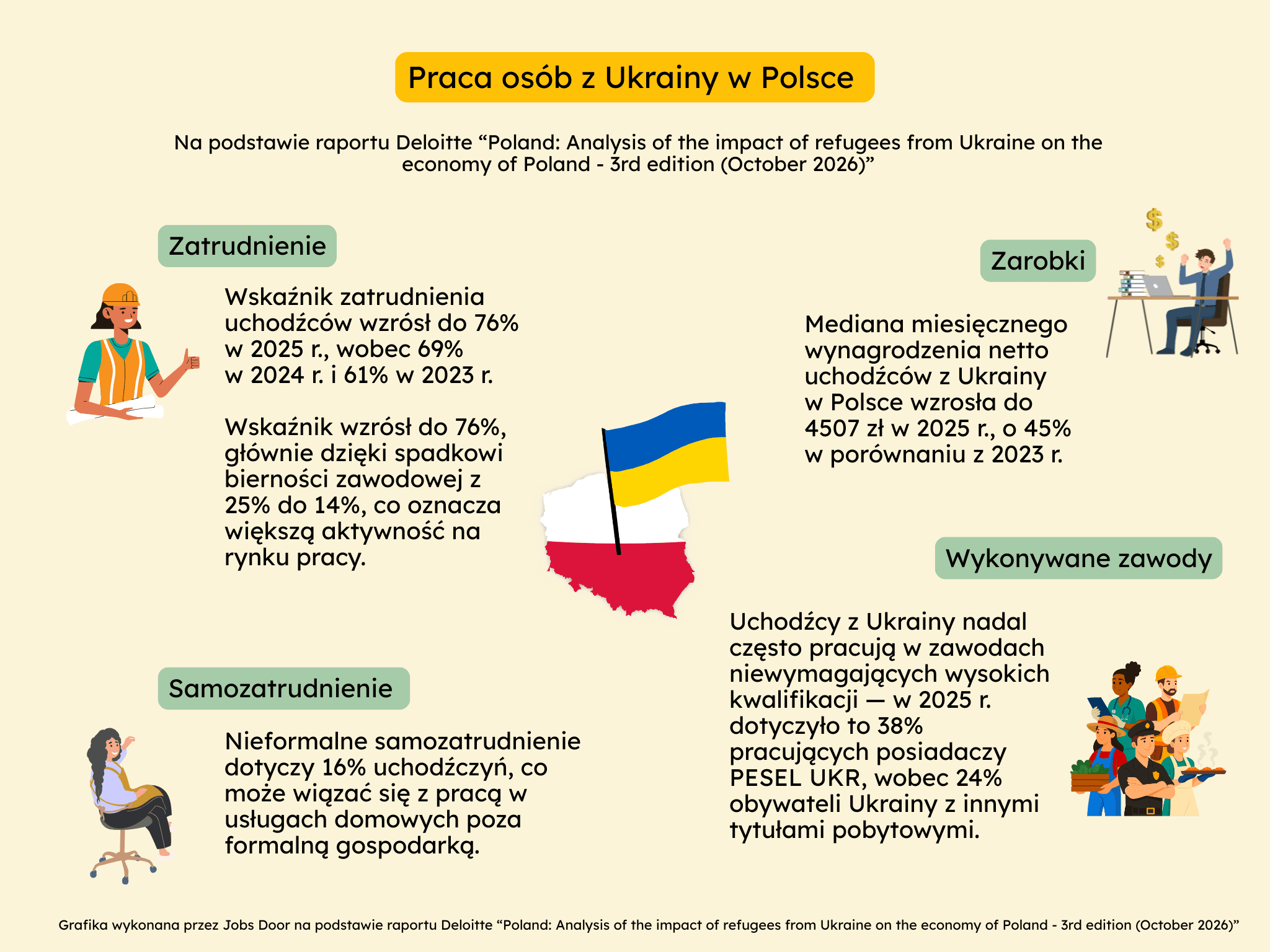
The professional situation of refugees from Ukraine is characteristic of people emigrating from more difficult living conditions to a country where the economy and prosperity are higher; people from Ukraine are more likely than Polish citizens to work in professions that do not require high qualifications. In 2025, 38% of working holders of PESEL UKR performed simple jobs, compared to 24% of Ukrainian citizens with other residence titles and 9% of Poles. At the same time, more than a quarter of working refugees were employed in trade, catering and accommodation services, sectors particularly vulnerable to the occurrence of the grey zone.
Although at first glance it might seem that the difference in employment of Poles and Ukrainians is due to education it is not always a question of acquired education. Some diplomas require formal recognition, and in regulated professions, e.g. doctor or nurse, additional requirements must be met in order to be able to practice the profession in Poland and the nostrification and recognition of qualifications is associated with the process. Another reason may be a language barrier and knowledge of local procedures, the need to get to work quickly and earn income and, unfortunately, barriers in the form of prejudice and aversion to another nationality. Self-employment and informal work are also important phenomena. In the study, 9% of working refugees declared informal work — 10% of women and 5% of men. Informal self-employment was reported by 16% of women, which may involve, among other things, the provision of domestic services outside the formal economy. However, this data should be taken as a bottom estimate, as some of the respondents may not disclose informal work.
In terms of earnings, refugees from Ukraine can count on a median monthly net salary of PLN 4507 in 2025, which was 85% of the median net salary in the entire Polish economy. These salaries increased by 45% compared to 2023, but their relative salary position remained close to the previous one. This may indicate that, despite the increasing professional activity of refugees, their earning potential is still limited, among others, by a mismatch of qualifications for the work performed.
summary
Deloitte data show that refugees from Ukraine play an important role in the Polish labour market: in 2025, 76% of them were employed and 86% remained professionally active. At the same time, many work in positions that do not require high qualifications, and their median monthly net earnings amounted to PLN 4507, which indicates the persistent differences with respect to the entire Polish economy. Barriers remain, among others, the recognition of qualifications, language requirements and the mismatch of education with the work performed, which means that part of the professional potential of refugees is not fully exploited.
Sources:


 Polski (PL)
 English (EN)
 Español (ES)
 العربية (AR)
 Українська (UA)