
Poor mental condition of teachers poses a threat not only to the professional group itself, but also to the quality of functioning of the entire education system in Poland. Although the topic of occupational stress is often rightly raised in the discussion of teachers, it is usually associated primarily with daily work with children and young people. Meanwhile, the results of the latest study show that some of the strongest sources of stress for teachers are systemic and result from the organization and functioning of Polish education.
Report from “A National Study on Psychological Risk and Stress in the Teaching Profession” published in June 2026. The study, commissioned by the Polish Teachers' Association by researchers from the University of Warsaw, included nearly 1800 education workers from all over Poland. The results indicate that teacher overload is not solely due to the nature of the work performed, but to a large extent to the conditions created by the education system.
Chronic stress as a systemic problem permanently anchored in the professional life of a teacher
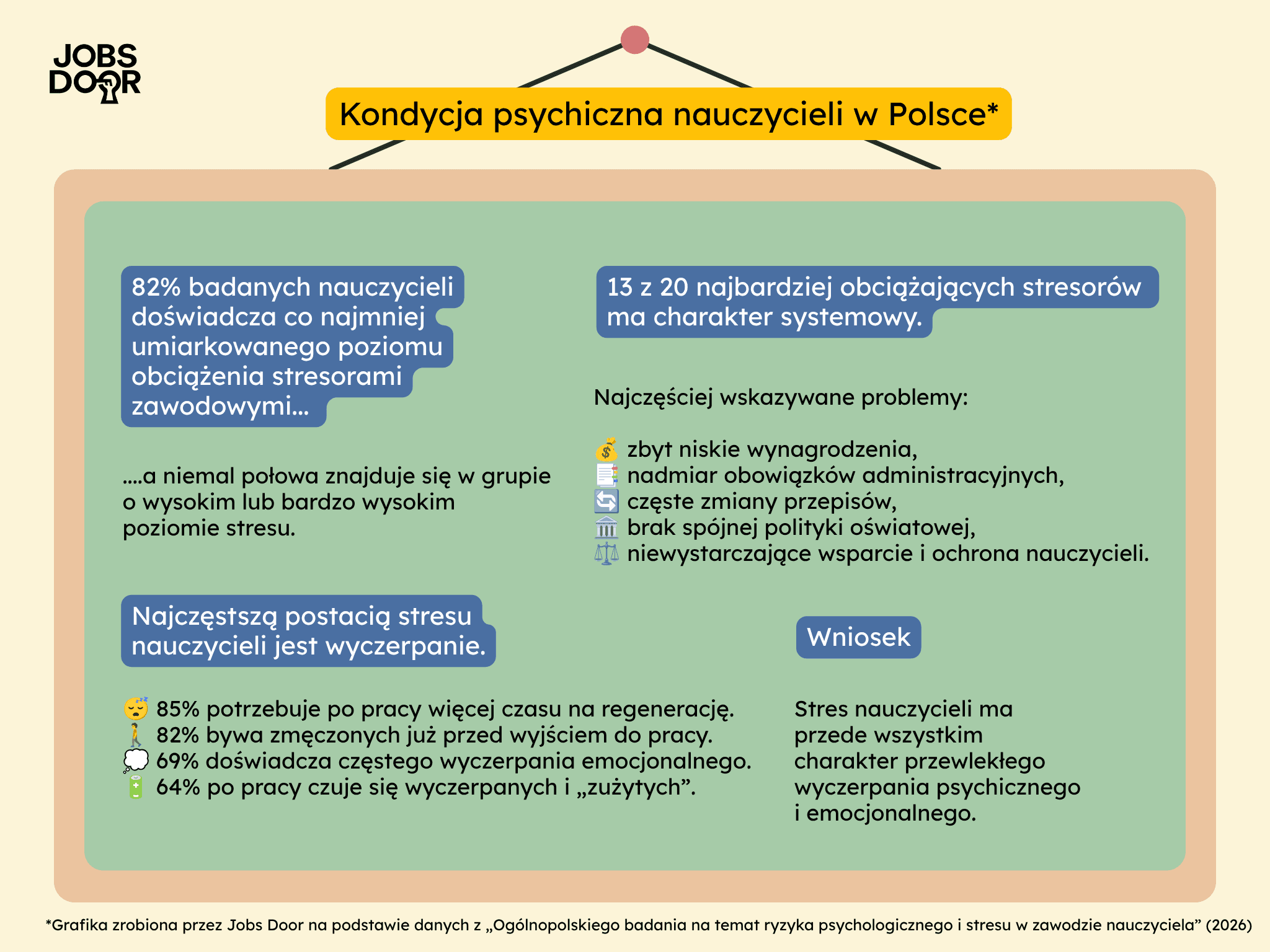
The results of the report show that the situation of teachers in Poland is really difficult. Occupational stress has ceased to be a marginal phenomenon — it has become a permanent element of work in this profession. The data paint a picture of schools where teachers have to manage their own emotions every day so as not to let themselves be completely absorbed by the growing tension. Stress is not incidental. Only 18% of respondents were in the group with a low level of occupational stress load, while one in two teachers experienced high or very high levels of cumulative stress load. This means that for most of those surveyed, stress is an everyday experience rather than a transitory episode.
The authors of the report emphasize that the problem of stress has become so strongly embedded in the school environment that it has ceased to be a periodic overload, which the employee can cope with thanks to short-term mobilization. It has become a permanent element in the functioning of teachers and a phenomenon of a systemic nature. In practice, this means that teachers are increasingly working in conditions of constant tension, and chronic stress has largely been normalized and has begun to be seen as an integral part of the profession.
The most stressful areas of a teacher's work
As highlighted in the report, teachers' professional stress is not solely a consequence of individual psychological predispositions or personality traits. It arises above all from the tension between the demands made by the job, the resources available to the worker and the level of support he receives in the professional environment.
The authors of the study, based on previous scientific findings, treated stress as cumulative load experienced in daily work. Five main areas of stress were identified for the study:
- organisation and working conditions,
- the work of the teacher in the kindergarten class or group and the relationship with students and children,
- relationships with parents,
- relationships in the pedagogical group and the role of the management,
- systemic factors.
Each of these areas was evaluated in two dimensions: frequency of occurrence of loads and subjectively perceived nuisance. Thanks to this, it was possible to determine not only which situations are the most stressful, but also how often teachers experience them.
The results of the study leave no doubt - the most burdensome turned out to be Systemic factors, that is, those related to the functioning of the entire education system. Out of the top 20 highest-rated stressors, up to 13 was of a systemic nature, which shows that the main sources of stress go far beyond working with students on a daily basis.
The most frequently reported problems were:
- too low teacher salaries,
- shifting responsibility for implementing change without providing adequate resources and support
- lack of a coherent and long-term education policy,
- non-adaptation of system requirements to the realities of the daily work of the school.
The lack of systemic solutions limiting the administrative burden on teachers, too frequent changes in educational legislation, undermining the autonomy of teachers by decisions of the educational authorities, underestimation of the teaching profession in society, lack of systemic support in working with students with diverse educational needs and insufficient legal protection for teachers were also highly ranked.
The conclusions of the report are unequivocal — the biggest sources of stress for teachers do not arise from contact with students, but from the conditions in which Polish schools operate. This means that effective stress reduction requires first and foremost systemic changes, not just actions aimed at teachers themselves, such as training in coping with stress or developing mental resilience.
Consequences: health and staying in the profession
The professional stress of teachers has clear consequences for both mental and physical health, as confirmed by the results of the study. Analysis of the severity of somatic symptoms showed that 42% of the subjects were in the group with very high severity of symptoms, and the next 18% in the high-severity group. This means that as many as six out of ten teachers experience serious complaints related to chronic stress.
The most commonly reported problems were chronic fatigue, lack of energy, sleep disturbances, and back, joint and headache pain. These complaints worsen during periods of increased workload and often lead to further health consequences, such as the need for psychiatric help or the implementation of pharmacological treatment.
These results are particularly worrying because they indicate that teachers' deteriorating health is not solely due to individual resilience to stress. In the light of the study, its main sources are systemic in nature and are related to the organization of work, organizational chaos and the conditions of functioning of Polish education. The authors of the report emphasize that the scale of the problem justifies the need for changes in educational and public policies that would limit the sources of chronic stress, rather than focusing solely on mitigating its effects.
In addition, according to the report, the stress load leads to changes in the career path of teachers — only 27.8% of respondents declare that they do not plan to leave the profession, and as the level of workload increases, the number of people considering changing jobs increases significantly.
Recommendations
The authors of the report also presented recommendations addressed to policymakers, stressing that reducing the professional stress of teachers requires above all multi-level changes, with particular emphasis on systemic reforms. Among the most important demands were: ensuring greater stability in education policy, improving the material conditions for the profession, reducing excessive bureaucracy, rational assignment of duties to teachers, developing systemic support in working with students with diverse needs and strengthening the protection of teacher-parent relationships.
The results of the study show that the problem of professional stress of teachers is not only an individual experience, but a consequence of the way the entire education system functions. Without organizational and systemic changes, it will be difficult to reduce the scale of burnout, improve the well-being of teachers and stop the outflow of employees from the profession. The mental condition of teachers today is not only a question of the health of education workers, but also one of the key challenges for the quality and future of Polish education.
Sources:
- https://znp.edu.pl/assets/uploads/2026/06/Stres-nauczycieli_Raport-koncowy-z-badania-ZNP-2.pdf
- https://znp.edu.pl/wyniki-ogolnopolskiego-badania-nt-ryzyka-psychologicznego-i-stresu-w-zawodzie-nauczyciela/


 Polski (PL)
 English (EN)
 Español (ES)
 العربية (AR)
 Українська (UA)