
Which employees are most lacking in Poland? The answers to this question are provided by the Occupation Barometer — a nationwide survey showing which professions are in short supply and where the number of candidates exceeds the demand of employers.
The Occupation Barometer, which monitors deficit, sustainable and surplus occupations, shows — with accuracy to the county — where in Poland there is a demand for employees in particular professions, and where there are more candidates than available job offers. Forecasts are made on the basis of a qualitative study conducted by labor market experts. Thanks to such an analysis, we can check whether the profession of interest currently has a “take” on the scale of the whole country or in the selected province, as well as to get an idea in which industries there are beginning to appear shortages of employees or surpluses of candidates. This tool is useful not only from the perspective of those planning their career path, but also for employers, public institutions and organizations for whom the labor market is an important reference point.
The unemployment rate in Poland remains low. According to the Central Statistical Office, unemployment recorded in June 2026 was 5.9%, while according to Eurostat's methodology the unemployment rate reached 3.1%, which places Poland below the EU average. The data show that the labour market is in good shape. Despite this, the Ministry of Family, Labor and Social Policy already presented on 30 January 2026 a draft regulation on the list of occupational groups in which there are personnel shortages.
So why is such a list needed? First of all, because its preparation follows from the recipes Act of 20 March 2025 on the conditions of admissibility of entrusting work to foreigners in the territory of the Republic of Poland (Journal of Laws item 621 with later amendments). Pursuant to Article 29 (1) of the Act, the Minister responsible for labour matters is obliged to determine, by means of a regulation, a list of occupational groups in which there are staff shortages. So while the situation remains stable from the perspective of the entire labour market, the government wants to determine more precisely in which occupations workers are most lacking, where the balance between labour supply and demand is maintained, and in which professions there are more candidates than available jobs. Staffing deficits are one of the most important indicators of the health of the labour market, particularly in the context of an ageing population. This is why for years we have seen a growing demand for, among others, health and long-term care workers.
At the same time, the list of deficit professions will also perform a practical function. Applicants for jobs in the listed professions will be able to benefit from simplified and priority procedures related to obtaining a work permit and, in certain cases, issuing a visa. This solution is intended to make it easier to fill the shortage of personnel in the most needy industries, while supporting employers and foreigners who want to legally take up employment in Poland.
Below we present a graphic prepared on the basis of Competition Barometer — Forecast for 2026, showing deficit occupations and occupations in which a balance of supply and demand in the labour market is maintained.
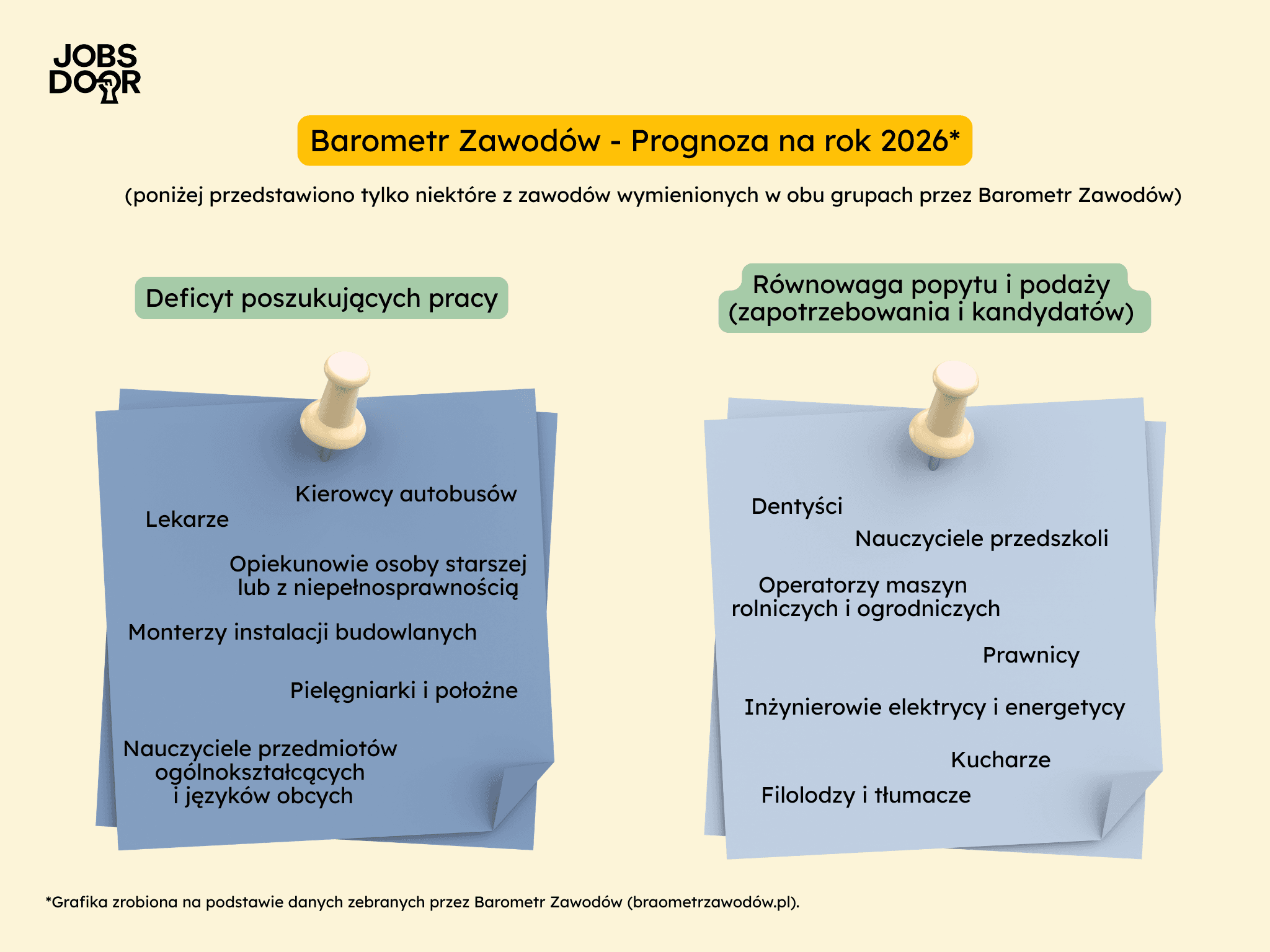
Needed: Doctors
According to the study Barometer of Professions We have the largest employee deficit in physicians. It was with this profession that the criterion was most often indicated “A large deficit of job seekers” — it appeared as far back as 40 counties in Poland. The most commonly indicated cause of deficiency is “There are not enough candidates for the job.”. This reason appears, among others, in the Wołomin (Mazowieckie Voivodeship), Nowosola (Lubuskie Voivodeship) or Limanowski (Małopolskie Voivodeship) counties. If we look at the map, we will see that the deficit of doctors occurs in very different regions of Poland. It is difficult to point out a clear geographical relationship here - the problem concerns both large cities and smaller counties.
Among the causes of the deficit, other answers also appear. In Goleniów County (West Pomeranian Voivodeship) it is indicated that “candidates do not meet the requirements of employers”, while in the counties of Kamień (West Pomerania Province), Gliwice (Silesian Voivodeship), Kwidzyn (Pomeranian Voivodeship) and Włodawa (Lublin Voivodeship) it was emphasized that “The job conditions do not suit the candidates.”.
In part of the counties, the authors of the Barometer also provided more detailed justifications. In Warsaw with a cause “There are not enough candidates for the job.” added a comment pointing to, among others supplying the labor market with foreigners (most often from Ukraine) and the fact that candidates do not meet the requirements of employers, e.g. due to lack of required qualifications or work experience. Such comments make it possible to better understand the real causes of staff shortages. They also show how important the Occupation Barometer is — not only in diagnosing gaps in the labour market, but also in the context of the growing number of foreigners taking up employment in Poland. These figures highlight the need to support them more effectively not only in finding a job, but also in the recognition of qualifications and the transfer of professional qualifications.
Needed: carers of an elderly or disabled person
It is also worth looking at the deficit of candidates to practice the profession caregiver of an elderly or disabled person. According to the map Barometer of Professions This profession is classified as characterized by “There is a huge shortage of job seekers.” in six counties and “Deficit of Job Seekers” in 196 counties.
Although there are professions where the number of counties with a “large deficit” is higher, this case seems particularly relevant. First of all, Polish society is systematically ageing, which will mean a growing demand for workers performing care professions. Secondly, this topic fits into the broader discussion on the development of the support system for people in need of care, including Draft Law on Personal Assistance to Persons with Disabilities, on which legislative work is currently stuck at the subcommittee stage. While personal assistance is not the same as a caregiver's work, both solutions address the development of caregiving services and respond to the growing needs resulting from demographic change.
The shortage of carers for the elderly and people with disabilities is part of one of the biggest challenges of the Polish labour market — the ageing population and the growing demand for care services. At the same time, attention is increasingly being drawn to the fact that a significant part of caring duties is still performed free of charge by family members, most often women. Ongoing work on the development of the system of personal assistance for people with disabilities shows that the state recognizes the need to professionalize and increase the availability of support services. Although personal assistant and caregiver are different roles, the development of these types of services may in the future partially relieve families and increase interest in working in the shadow sectorout.
summary
The Occupation Barometer shows that despite the good condition of the labor market, staff deficits remain one of the biggest challenges for many industries. They are particularly evident in healthcare and the care sector, where the situation is affected by both demographic changes and a shortage of skilled workers. These data can provide valuable guidance for employees, employers and decision-makers planning the development of the labor market.
Sources:
- https://barometrzawodow.pl/modul/prognozy-na-plakatach?form-group%5B%5D=all&publication=national&year=2026&utm_source=chatgpt.com
- https://legislacja.rcl.gov.pl/projekt/12406652/katalog/13183494#13183494
- https://pracodawcy.pl/projekt-rozporzadzenia-ministra-rodziny-pracy-i-polityki-spolecznej-w-sprawie-wykazu-okreslajacego-grupy-zawodow-w-ktorych-wystepuja-niedobory-kadrowe/?utm_source=chatgpt.com
- https://www.gov.pl/web/rodzina/projekt-rozporzadzenia-ministra-rodziny-pracy-i-polityki-spolecznej-w-sprawie-wykazu-okreslajacego-grupy-zawodow-w-ktorych-wystepuja-niedobory-kadrowe?utm_source=chatgpt.com
- https://ssgk.stat.gov.pl/Rynek_pracy.html


 Polski (PL)
 English (EN)
 Español (ES)
 العربية (AR)
 Українська (UA)