
Until recently, it seemed that generational differences would be one of the greatest challenges of modern organizations. Baby Boomers, Generation X, Millennials and Gen Z all have different experiences, expectations and work styles. But does age really determine how we work together?
The second part of the report “Strength in Diversity” shows that the reality is much more complex. Yes, generations differ in what motivates them to work as a team, but at the same time, surprisingly, they often agree on the issues that determine the quality of everyday collaboration. Moreover, the results of the study challenge several popular stereotypes. It turns out that regardless of age, we value direct conversation, react similarly to the lack of involvement of colleagues and in the vast majority see the value of working in intergenerational teams.
What makes us different? What unites us?
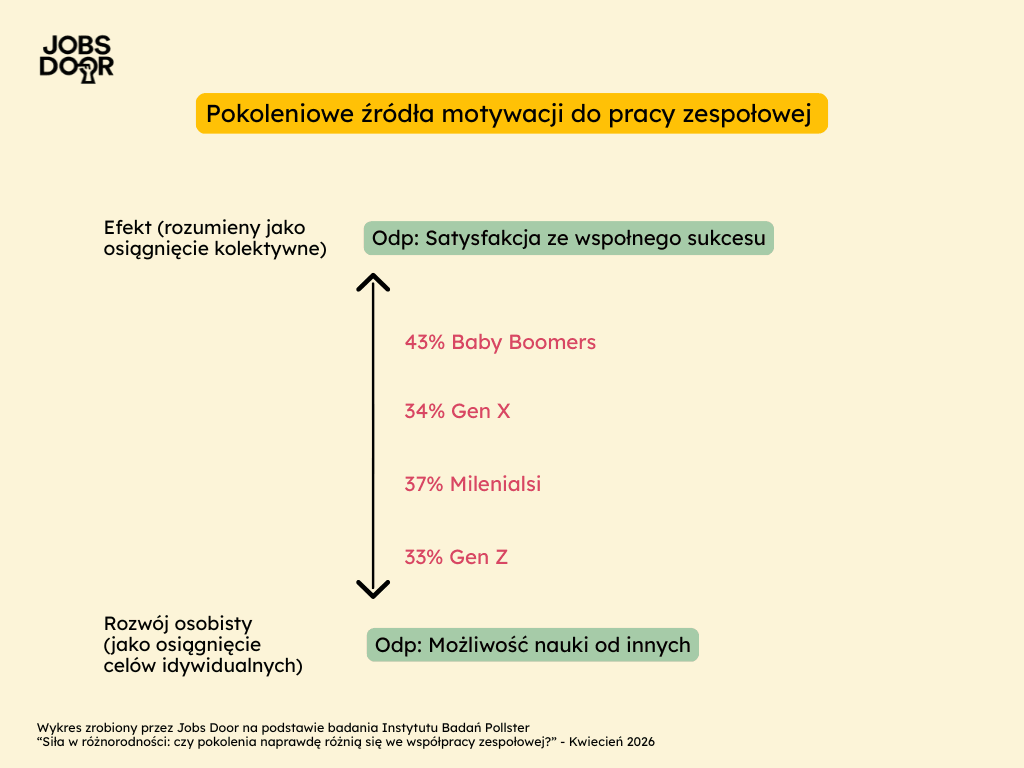
The clearest difference in the report when it comes to the approach to team collaboration concerns the motivations of individual generations. For each of them, the main motivator is different — it concerns satisfaction with a jointly developed solution, exchange of experiences or opportunities for development and learning from others.
A clear pattern emerges from the collected data: the older the generation, the more often the motivation for cooperation is the jointly achieved result. As many as 43% indicated the need for motivation in the form of satisfaction from achieving a common goal, which clearly distinguishes them from the youngest generation - Gen Z. For representatives of this generation, the most important motivator is, first of all, the opportunity to develop and learn from others (33%). This shows an interesting approach to the cooperation itself. Older generations seem to think more collectively — through the prism of working together and the result achieved together, and to a lesser extent through the prism of their own benefit. Gen Z, on the other hand, seeks motivation primarily through the individualization of goals. Even if the path to their realization leads through teamwork, in the end this generation cares about personal development and broadly understood self-realization.
The closest to such an attitude are slightly older Millennials. It was they who most often indicated the exchange of experiences (37%), and in second place the opportunity to learn from others (26%). Interestingly, Gen Z remains somewhere between these choices — they just as often indicated an exchange of experience (34%) as well as satisfaction with a jointly developed solution (29%).
However, the diversity of generations does not mean only differences. Jif it turns out, there are areas in which representatives of all generations think almost identically. The study found that what connects generations most strongly is similar frustration—the moment when they observe a lack of commitment from others when working as a team.
The results are surprisingly similar, regardless of when the respondents were born:
- 57% — Baby Boomers,
- 48% — Generation X
- 51% — Generation Y (Millennials)
- 55% — Generation Z.
This is one of those areas where age ceases to matter. Regardless of the generation, the lack of involvement of colleagues remains the biggest source of frustration in teamwork.
As highlighted by the report's expert, Magda Pietkiewicz, CEO of Enpulse, co-owner of Zowani.pl and employee engagement expert:
The result of this study is very significant. Since the lack of involvement of colleagues has been indicated as the greatest frustration in teamwork, and the responses are surprisingly consistent in this regard in all age groups, it is difficult to speak of a problem of one generation. Rather, this report shows something else: that the source of tensions in teams is not primarily generational differences, but the quality of day-to-day collaboration.
Communication in the team: face to face or online?
It would seem that younger generations, already growing up largely in the digital and virtual world, will be more likely to avoid open confrontation and lean towards emails, chats and other modern communication tools. However, the report shows something completely different. Here, too, the generations are extremely compatible - each of them by far the most often chooses face-to-face conversation as the preferred form of communication in the team.
89% of Baby Boomers, 85% of Generation X, 73% of Millennials and 72% of Generation Z.
This shows that companies that are increasingly investing in the next communication “facilitators” may not always solve the right problem. It is possible that instead of improving communication, they add more channels and produce even more content that is difficult to process. Looking at this data, one gets the impression that one face-to-face conversation can do more than a long conversation on Teams or a few emails mentioned. It is not for nothing that many organizations today face an excess of information and messages that are lost in the rush of notifications, chats and unread messages. Moreover, textual communication, although in theory it is intended to simplify cooperation, often becomes a source of overinterpretation or simple misunderstanding. It is more difficult to read the intentions of the interlocutor, emotions or context, and it is these that often determine the effectiveness of communication.
So perhaps instead of investing exclusively in more messaging apps and platforms, organizations should focus more on developing employees' communication skills — teaching conversation, constructive feedback and effective face-to-face collaboration. Because as the results of the report show, regardless of generation, it is the direct conversation that remains the most effective and desired way of communication.
What do generations think about intergenerational cooperation, and what kind of cooperation do they choose in reality?
Another reason to be surprised — and at the same time to be optimistic — is the very positive attitude of all generations towards intergenerational cooperation. With the statement: “Collaboration in an intergenerational team brings many benefits” 89% of respondents agree.
The most convinced of the value of such teams are representatives of Baby Boomers. 97% of them believe that working in mixed-age teams is beneficial. One can get the impression that it is the oldest generation that best perceives the value of the exchange of experience and different perspectives. At the other end of the spectrum is Generation Z. Although it is also mostly positive about intergenerational cooperation, it does so with greater caution. As the results of the report show, about one in eleven Gen Z representatives disagree with this statement, and among those who agree, the answer “I rather agree” than “strongly agree” appears much more often.
This shows that although the idea of intergenerational cooperation is widely accepted in all age groups, the level of enthusiasm for it is no longer the same. The older generations seem to approach it with more conviction, while the youngest perceive its advantages, but more often maintain a certain distance.
summary
The report shows that generational differences exist, but they are not the biggest challenge for modern organizations. Much more important are the quality of communication, commitment and the ability to use different perspectives in working together. It is these elements — more than metrics — that determine the effectiveness of teams today.
Sources:
https://pollster.pl/files/reports/Raport-Sila-w-roznorodnosci-Pollster.pdf


 Polski (PL)
 English (EN)
 Español (ES)
 العربية (AR)
 Українська (UA)