
Reforms in the area of platform work are necessary and require the involvement of many organisations, and above all politicians, in order to effectively protect workers from insecurity — both in terms of working conditions and from the dramatic economic consequences and job insecurity. We have already written about platform work in the context of its unstable conditions and often (non) responsibility of large corporations (e.g. transport companies), for which the profitability of the employee model “for hire” often translates into high profits. However, these benefits are not experienced by “regular” employees themselves (read: Challenges of Temporary Work: Platform Economy & Precariat).
Today we can observe changes that, perhaps, will affect this area of the labor market; International Labour Organization (International Labour Organization, ILO) published an article entitled “How will the new Convention No. 193 promote decent work in the platform economy?” in which he explains the assumptions Newly Adopted Convention No. 193 — the first international work standard dedicated to the platform economy. The publication answers questions, among others, who will be covered by the new rules and who will be covered by the new rules and what obligations will fall on digital platforms and countries.
What is platform work?
Platform work is one of the elements digital economyj, which is based on the use of technologies and online platforms to connect service providers with their customers. It is thanks to applications such as Uber, Glovo or Bolt that we can order a ride or delivery in a few minutes, and the whole process takes place almost without the participation of traditional intermediaries. While such a model has become synonymous with convenience and flexibility, it has also been controversial for years related to precarious employment conditions, the liability of platforms and the protection of the rights of those who work through them.
The development of the digital economy has also led to the emergence of a phenomenon referred to as Precariate — groups of people working in precarious employment conditions. This applies primarily to people who work through online platforms, who are characterized by unstable incomes, limited access to social security and little protection under labor law. Although platform work is often presented as a synonym for flexibility and independence, in practice many employees remain dependent on algorithms, user evaluations or changing operating principles of platforms. As a result, their professional and economic situation tends to be much less stable than the “self-employed partner” model suggests.
However, this problem goes beyond the issue of remuneration. The question of responsibility for health and safety at work, social protection and the rights of workers performing their duties through the platforms remains open. It is these challenges that have become one of the main reasons for starting work on new international regulations.
What rights and means of protection does the Convention provide and who does it cover?
Convention 193 covers all persons who perform work through digital platforms — whether they are employed on the basis of an employment contract or provide services as self-employed persons. It guarantees them basic labour rights, including the right to safe and dignified working conditions, social protection, fair pay and protection from discrimination, violence and harassment.
For the first time, the issues of algorithmic management have also been regulated at the international level Platforms will be required to inform employees about the use of algorithms to monitor and make decisions and provide an opportunity to appeal decisions, such as account suspension or deactivation. The Convention also obliges States to properly determine the employment status of platform workers and to effectively enforce provisions protecting their rights.
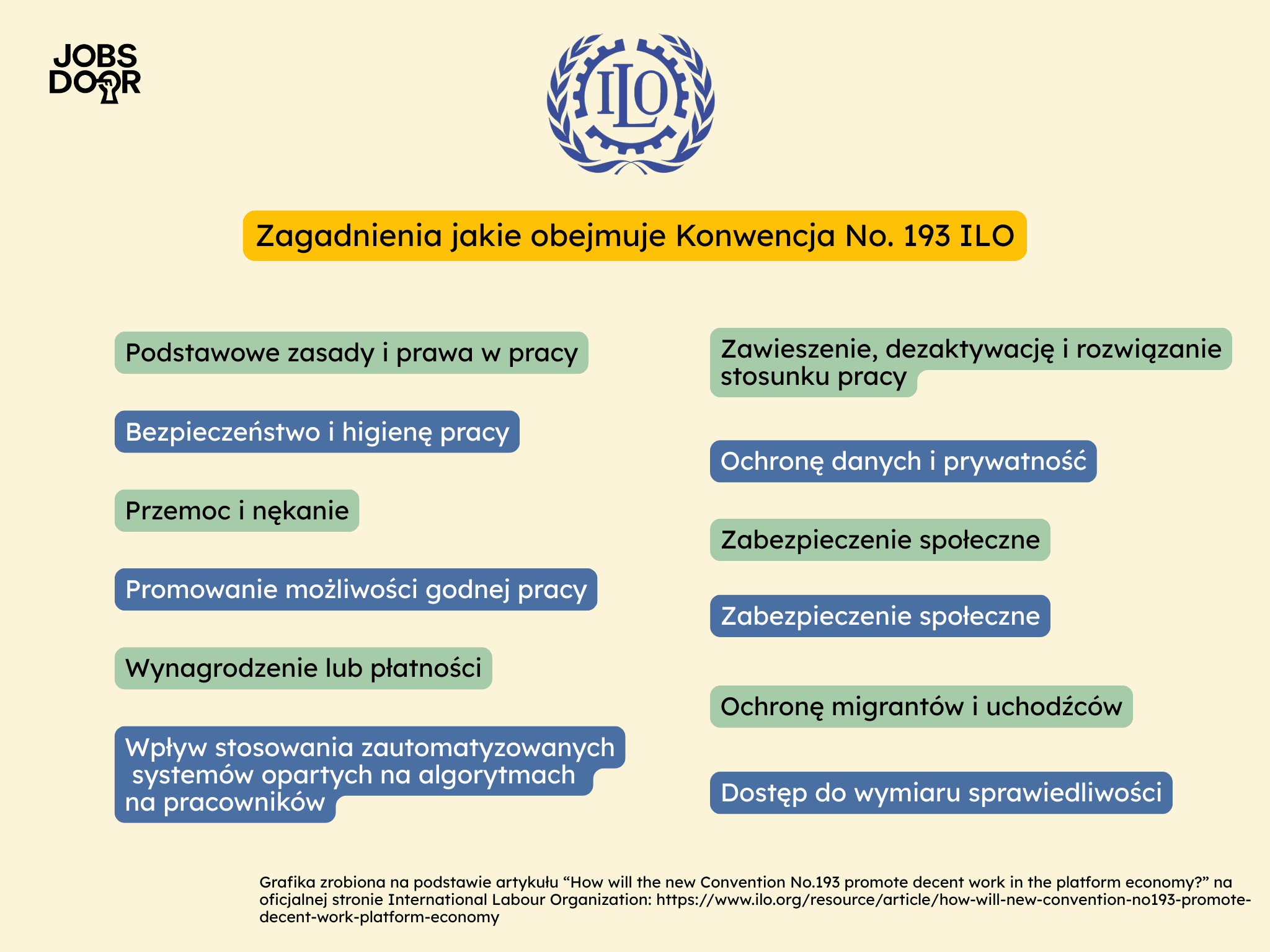
Although Convention No. 193 does not automatically apply in all member states of the International Labour Organization and requires ratification by individual countries, its assumptions are in line with the direction of change observed in Poland as well. A good example is this year's reform of the State Labour Inspectorate, which strengthens the tools to fight so-called “junk contracts” and fictitious self-employment. The new rules are intended to facilitate law enforcement in situations where civil law contracts replace the employment relationship and workers are deprived of their rights and protection.
Sources:
- https://jobsdoor.eu/pl/aktualnosci/wyzwania-pracy-tymczasowej-platform-economy-and-prekariat-UmjCdmtatgfjZxomQ6CV
- https://www.ilo.org/resource/article/how-will-new-convention-no193-promote-decent-work-platform-economy


 Polski (PL)
 English (EN)
 Español (ES)
 العربية (AR)
 Українська (UA)