
Demography in Poland, although other European countries have similar challenges, has significantly influenced the Local Labour Market Policies and Forecasts. Falling fertility, a growing disparity between the younger and older generations, and lengthening life expectancy are a combination that not only shapes cultural-social change, but It has a real impact on the labour market. The topic of the so-called “generation” has been appearing in the media for several years.silversAccording to various scientific sources, these are people 45+, 50+ and older, including generations X, Y and Z (sometimes also referred to as “boomers”). In the scientific area, there have also been reports on the functioning of these generations, also in the professional context. The conclusions were not comforting — studies have shown that people 50+ are often overlooked when recruiting for new jobs, and media terms such as “silver” or “boomers” instead of a neutral narrative often create an image of a group that, due to age and beliefs, supposedly does not fit into modern social reality. We had a similar situation with “Zetek”, to which a patch of “lazy and demanding” employees was quickly pinned in the media.
Today, in Poland, negative natural growth and population decline to 37.4 million (GUS 2025 data), we should especially pay attention to the 50+ generation. This is not about creating a group with permanent characteristics that perpetuate the stereotype, but about trying to understand what older people face — for example in the labour market — in order to be able to respond to the challenges of today.
The latest report, which comprehensively addresses the topic of the 50+ generation in professional reality, is Age force — people 50+ in the labour market (2025), made to order Central Institute of Labor Protection — State Research Institute. The survey is part of a nationwide information campaign entitled “The Power of Age”, aimed at employers and workers 50+, implemented with funds National Health Programme 2021-2025 and financed by Minister for Family, Labour and Social Policy.
People 50+ and 60+ on the job market: why say “YES” to them?
First of all, because neglecting their competence and experience is a huge loss for us - both for employers, colleagues and society as a whole. For employers, this means no professionally experienced employees. Such experience does not have to be limited to a specific industry - it is important, for example, experience of working in different conditions, the ability to work in a team or management skills. It all consists of Valuable skillswhich are sometimes lacking for young people just entering the labour market. For coworkers, a seemingly age-uniform team may seem ideal, but research shows that age-diverse teams work more creatively — provided that the company takes care of the appropriate training and preparation of the group beforehand. The key to successful cooperation is Competent management of generational diversity.
For society, the inactivity of people 50+ and 60+ is associated with a risk of social exclusion, which is reflected not only on intergenerational relationships, but also on the deteriorating psychological condition of older people. Consequently the lack of presence of older generations in the labor market also affects the economic and economic situation of the country. We need employees of all generations, even if there is increasing talk of the possibility of replacing them with automation.
Occupational barriers of the older generation
The CIOP-PIB report cited data from Surveys of Economic Activity of the Population (BAEL, GUS 2021), which showed that in 2021 in the age range of 55—64 years, the most common reasons for professional passivity were as follows:
- women — Retirement
- men — illness or disability
It is worth noting that among women up to 81% was retiring. This is partly an effect Low retirement age in Poland, compared to other countries. In addition, it operates in Poland protection against dismissal at pre-retirement age (covering four years), which, on the one hand, protects employees and, on the other hand, ensures that employers are less likely to hire people of pre-retirement age. Concern about the costs of implementing and training older workers results in their CVs being overlooked, leading to the belief that for older people there are no jobs. As a consequence, even those who wish to remain professionally active after reaching retirement age, often They are afraid to return to the job market. Another barrier is family responsibilities, especially in the case of women, often associated with the care of adult dependents. It is an invisible, undervalued caring function that, with age and the possibility of retirement, can be seen as their “default role”. Additionally lack of jobs tailored to the needs of older generations, such as part-time work, makes it difficult for this group to work.
All of the above barriers are of a nature Systemic and require attention from social policy and the labour market. It is mainly up to employers whether people 50+ and 60+ will be professionally active. However, this is the end of restrictions. The report also indicates cultural and social barrier, called ageism Prejudice and discrimination against older people. Ageism is associated, among other things, with older generations are rarely present in media, social media and culture, which makes it difficult to know their real competencies and needs. The lack of media representation leads to the duplication of stereotypes, and culture, art and fashion are largely aimed at youth, vitality and productivityThis marginalizes the elderly.
Sociological and pedagogical sciences also pay attention to the changing family modelwhich increasingly results in Loneliness of the elderly. In the publication of Adriana Bieli Social exclusion of seniors in the postmodern culture of the 21st century (2023) indicated that multigenerational families are becoming increasingly rare. Referring to Barbara Szatur-Jaworska, the author distinguishes the following types of farms for people 65+:
- People who live alone — 22%
- Marriage — 32,2%
- families consisting of an elderly person, their children and grandchildren — 10,1%
And:
- married couples living with children
- families consisting of an elderly person and their children
- married couples living with children and grandchildren
Other studies cited by Biela examined the attitude of society towards seniors. It follows from them that kindness to the elderly occurs most often in shops (40%) and in former workplaces (23%). In turn negative attitudes predominate in health care facilities (38%), public offices (35%), means of communication (26%), public spaces, the so-called “street” (28%) and among younger people (30%).
The authors of the study point out that education and age have an impact on attitudes towards seniors: the higher the education, the less the propensity to perceive the elderly as a burden, and the most favorable for seniors are middle-aged people, with favorability decreasing with age. With such research, we can better understand what it is Structural exclusion of older generations and what impact it has on their position on the labour market.
Generations 50+ at work: what are they like?
In the report The power of age The authors point out that intergenerational solidarity and good communication are fundamental for the professional activity of people 50+. Referring to concepts such as generational gap (differences in culture, style and way of life) and generational equity (equality and equitable distribution of resources between generations), the researchers remind that intergenerational relations have a key impact on the social and economic condition of the country.
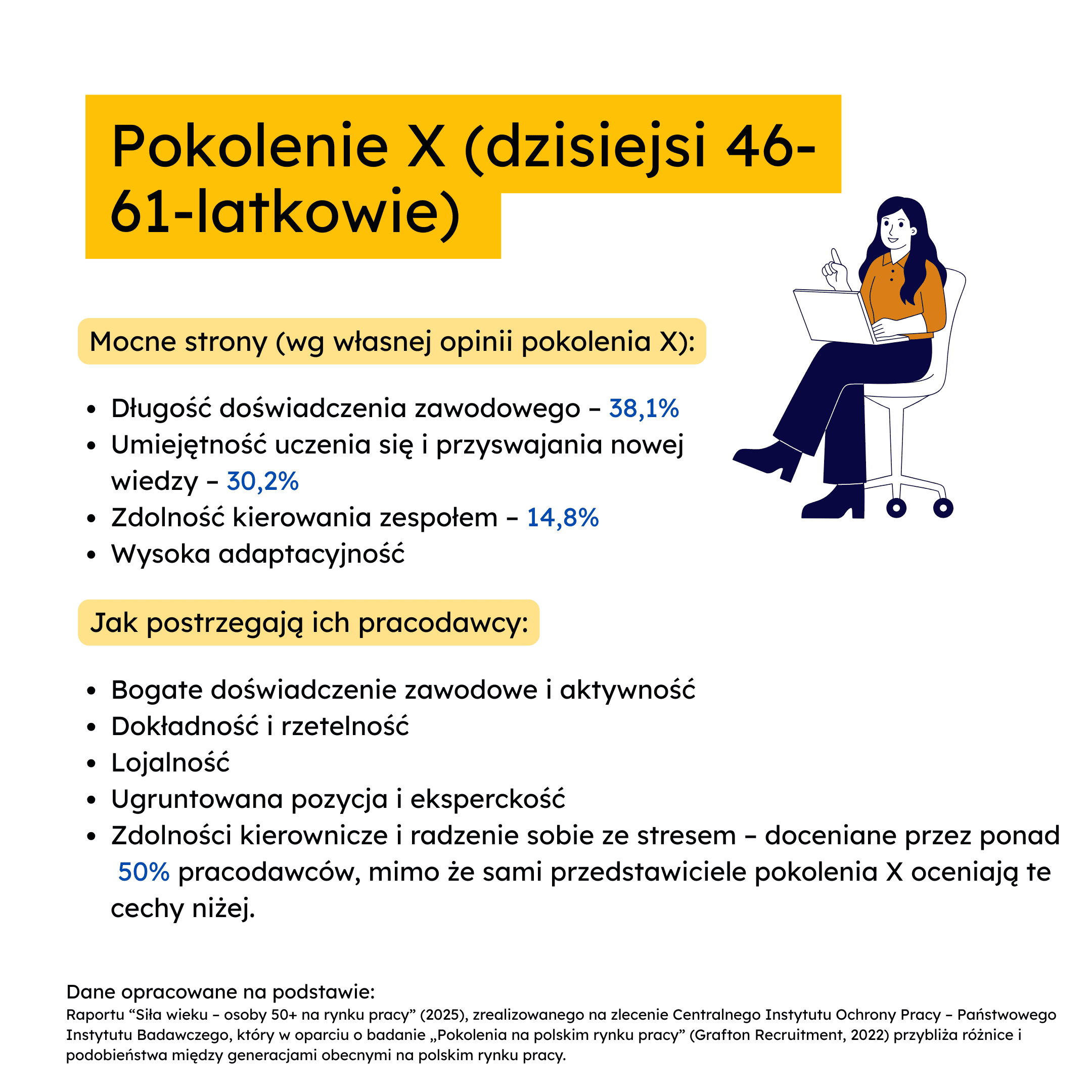
However, the fundamental question in the context of generational diversity in the labour market is: What are the differences and similarities between the generations in Poland? The report cites a study “Generations on the Polish Labour Market” (Grafton Recruitment, 2022), which shows the most important generational aspects. Looking at the picture of generations Baby Boomers (approximately 62 to 80 years) and X (46-61 years), we can highlight several key points. It is noteworthy that in both the Baby Boomers and Generation X the subjects rated their ability to lead a team quite low. As the CIOP-PIB report indicates, this may be due to the fact that these people mostly worked in the realities of the PRL, where it was more difficult to gain experience in managing colleagues and employees. At the same time, it highlights today's conviction of older generations about the lack of their own managerial and leadership competencies. Why? Because in the new, contemporary socio-economic order, many positions requiring experience and higher qualifications are associated with tasks reminiscent of managerial ones; supervision, organization of team work or responsibility for others. Older generations may be apprehensive about this type of recruitment, even if they meet most of the requirements. Let's not fool ourselves: the work of managing and organizing the work of others requires A lot of responsibility and training. The question is: is the company ready to hire such an employee - experienced and at the same time in need of additional competencies - and devote time and resources to properly prepare him for work? At first glance, the process seems time consuming and expensive, but from a further perspective, it is worth considering whether the lack of training and mentoring offers does not mean that we lose a group of really competent and experienced employees in their fields.
.png&w=3840&q=75)
Top 3 Work Values for Baby Boomers and Generation X
If we recall the narrative around millennials and Gen Z, which has often been highlighted as valuing freedom and flexibility above all in a dynamic work environment, it is not surprising that older generations value much more Confidence and safety. This is clearly seen in the differences between parents and children of these generations in the perception of what employment should provide.
For Baby Boomers job stability and security ranks first in the hierarchy of work-related values — 59% of respondents indicated this. In the case of Generation X This figure is in third place, winning 51% of the vote.
Other values from the podium are:
- Atmosphere at work — 53% among BB, 53% among X
- High salary — 46% among BB, 59% among X
Recommendations for Employers
Referring to both the macroeconomic situation and the local Polish situation, today we should pay more attention to the professional activity of people 50+, taking into account their needs and the values they value at work. From the point of view of employers, openness is recommended already at the recruitment stage, which can be supported, for example, by a clear declaration on anti-discrimination policies in terms of gender, race, age, sexual orientation or origin. Such a clear definition of the position of the organization promotes more inclusive recruitment and at the same time influences the positive image of the company.
The CIOP-PIB report recalls that Article 183a of the Labour Code stipulates that workers shall be treated equally in respect of:
- establishing and terminating an employment relationship,
- conditions of employment,
- promotion,
- access to training to improve professional qualifications.
This clearly shows that the Polish employer is obliged to comply with the law that does not allow discrimination on the basis of age. It is also worth introducing elements in organizations that facilitate intergenerational processes, such as: preventing negative practices, such as unequal treatment or stigmatization, taking into account the different health and family needs of workers 50+, developing the competences and potential of older workers.
Sources:
- https://www.ciop.pl/CIOPPortalWAR/file/101063/Raport-Sila-Wieku-osoby-50plus-na-rynku-pracy-CIOP-PIB2025.pdf
- https://izss.uken.krakow.pl/wp-content/uploads/sites/13/2023/01/Adrian-Biela-Wykluczenie-spoleczne-seniorow-w-kulturze-ponowoczesnej-XXI-wieku.pdf
- https://www.parp.gov.pl/storage/publications/pdf/Starzenie_sie_spoleczenstw.pdf


 Polski (PL)
 English (EN)
 Español (ES)
 العربية (AR)
 Українська (UA)