
Global data: Poland on the grey end of confidence
According to the Ipsos Global Trustworthiness Index 2024, the most trusting societies are in Asia, including Indonesia, India and Thailand. Unfortunately, the situation in our region looks completely different - countries such as Poland, Hungary or Romania were at the end of the scale, and Poland reached a score of -319, one of the lowest in the scale.
A closer look at the professional group of scientists and researchers: how does the world trust them?
Staying with the scientists: The study, which involved almost 72,000 respondents from 68 countries, examined the extent to which scientists should be involved in social life and policy decision-making, as well as what issues should be prioritized and how this relates to trust in science. The study, described in the article “Trust in scientists and their role in society across 68 countries” in Nature Human Behavior, used a multivariate index of trust. The average score among all countries was 3.62 on a five-point scale (1 - very low, 5 - very high), and in no state has low confidence in scientists been recorded.
From a global perspective scientists are one of the professional groups enjoying a relatively high level of trustThis is demonstrated by an international survey of nearly 72,000 respondents in 68 countries. Most people declare that they trust scientists and believe that they should play a significant role in social life and public decision-making processes, which can be particularly important in the face of global challenges such as the pandemic or climate change. Although the level of trust varies between countries — from moderately high in Egypt and India to relatively low in Albania or Russia — the overall picture suggests that Confidence in the competence of researchers remains high, and scientists are seen as qualified, honest and committed to the common good.
Doctors, firefighters and scientists on the 1st place in the rankings in Poland
As research shows, most often we trust professions that require a lot of responsibility and concern for our safety. These are primarily medical professions, but also those that are widely recognized as prestigious, such as the pilot of a passenger plane. At the top of the ranking, the profession has reigned for years Firefighter, which, in principle, invariably maintains its social position - this is a work about which the public speaks not so much flatteringly, but even emphasizes its extraordinary toil and danger. And although the profession physician He is one of the most demanding and in many risky moments, he has never enjoyed such a high degree of trust. This is probably due to its diversity and overall perception of the health care system.
For the fifth time, SW Research presented its analysis on the respect of particular professions by Poles. In the 2025 study, the kit was included for the first time pilot of a passenger aircraft, which immediately ranked high, with a score of 81,0%. Only the professions are listed above: paramedic (81,5%) and Firefighter(83,0%).
Similar observations are brought by the CBOS study from 2025, in which firefighters, nurses and doctors also dominate the top of the ranking. Among the professions that are highly valued socially, there are also professions that are not always associated with prestige in the media, but enjoy great social respect - including miners and skilled workers.
CBOS 2025 Results The prestige of professions, that is, which professions currently enjoy the greatest social respect:
- Firefighter (95%)
- nurse (91%)
- Skilled worker, e.g. lathe, bricklayer (87%)
- Miner (83%) and Engineer working in the factory (83%)
- University Professor (82%)
- Individual farmer on a medium farm (81%)
- physician (80%)
- Maestro (79%)
According to the authors of the study, in comparison with the results of 1995, there is a clear decrease in respect and respect for the so-called intelligentsia professions in Poland. Once university professor, judge or journalist held much higher positions in the rankings - the last two competitions achieved results in the range 60-70%.
We don't trust them: politicians, influencers, clergy
According to a study by SW Research (2025) Influencers and YouTubers have been closing the social esteem ranking for years - this year their ratings were 13.6% and 13.8%, respectively, and politicians (Members of the European Parliament and Members of the European Parliament) received only slightly more than 20% of positive reviews. Similar results are produced by the CBOS survey (2025), where the least valued professions are, among others, a stockbroker (30%), a politician (17%) and an influencer (10%), while Internet and Internet creators ranked slightly higher. clergy (34% each).
Internationally, according to the Ipsos Global Trustworthiness Index (2024) In Poland, respondents ranked politicians (8%), managers responsible for advertising (12%) and clergy and priests (13%) as the least trusted professions, while influencers and bankers ranked slightly higher (15% each). All these studies consistently show that politicians, Internet creators, and Church representatives are at the bottom of the social hierarchy of trust, regardless of the methodology adopted or the scope of the sample.
Female and male forms of professions
The topic of the importance of trust in the context of the perception of specific professions undertaken Sociologists.pl, which asked respondents how trustworthy individuals in particular professions were. This study stands out from the others primarily in that the level of trust is analyzed separately for the female and male forms of the same profession. This approach allows you to capture not only the emotional attitude towards a particular professional group, but also to gender entered in the name of the profession and to the social and cultural roles that are associated with it. In this sense, the study shows that trust is not only about professional competencies, but also about the linguistic and symbolic framework in which a job is perceived.
However, it should be emphasized that the study does not present a distribution of responses according to the gender of the respondents. This means that we do not know whether higher or lower confidence in a given professional form was declared more often by women or men. The available data shows only overall level of confidence in the female and male form of the profession in question in the whole study sample. By the same the study does not answer the question who more often trusts a given form, but it shows very clearly that the linguistic form of the profession itself is important for social perception and the level of trust.
Why is such a study relevant and broadens our understanding of social reality? Because work has never functioned in isolation from social status, origin, race or gender. Although the Socijolożek.pl study only touches on one of these dimensions, it remains unique in the context of analyses concerning the trust, prestige and social position of professions. It shows how strongly social and personal beliefs, also fixed in language, influence our evaluations. It is also worth noting the linguistic aspect of similar studies and on consistency (or lack thereof) in the choice of forms of profession. In part of the available research, we encounter a situation in which e.g. surgeon, but not surgeon, or nurse without its corresponding male form. The study Socijolożek.pl stands out against this background by trying to capture both forms, which makes it possible to directly compare their social perception.
Question used in the study: “How trustworthy is the person in this profession?” and the results of the study are as follows:
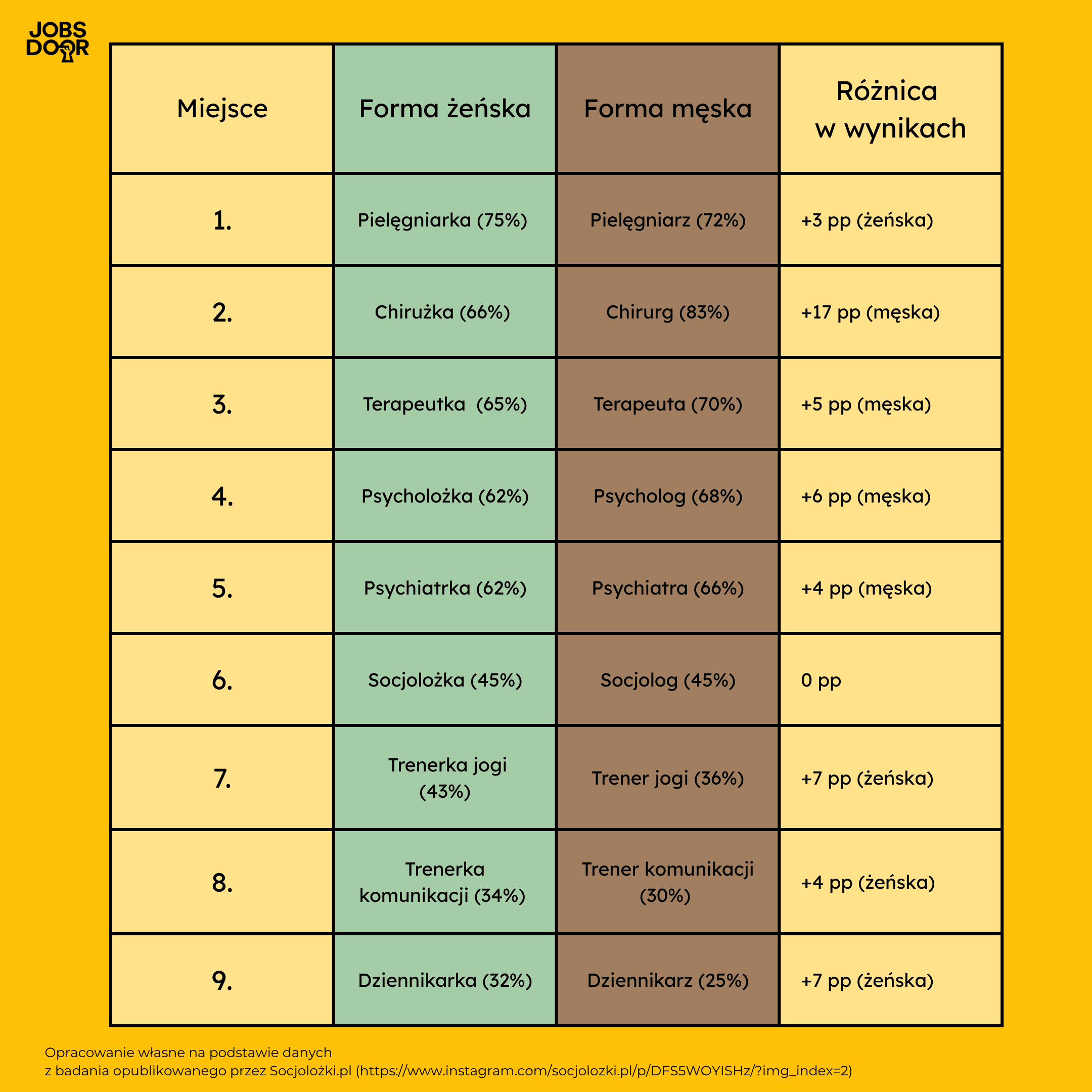
The results show that - especially in the case of medical professions - more confidence is given to the male form, and thus persons perceived as male in a given profession. Apparently, this can be seen in the case of the couple surgeon/surgeonwhere the difference in the level of trust goes as far as 17 percentage points. The smallest difference within the medical profession, on the other hand, concerns the couple nurse/nurse, which may be surprising given the strong feminization of the profession in recent decades. However, this result may suggest a gradual normalization of male presence in care professions or a weakening of stereotypical gender associations with the profession.
Among the other professions, the greatest neutrality, understood as the absence of a difference in the level of trust, was obtained by the couple sociologist/sociologistwhere the difference was 0 percentage points. The largest discrepancies were recorded ex aequo in the case of couples yoga coach/yoga trainer and journalist/journalist - in both cases the difference reaches 7 percentage points, with the female form being rated higher. In the case of yoga, it is difficult to clearly indicate the motives behind such a result, especially since the practice itself, at least in the Western cultural circle, tends to be strongly associated with women. For journalism, on the other hand, higher confidence in the female form may be due to the visibility of women in the media and their increasing representation in the profession. Usually, a greater presence of a given gender in a particular profession favors its identification with that profession, which can translate into a higher level of social trust.
summary
The results of the research show that trust is not only an effect of prestige or remuneration — it strongly depends on perceived responsibility, social role and cultural stereotypes. The analysis of Socijolożek.pl indicates that even the linguistic form of the profession affects the perception of society. This shows how complex and multidimensional the mechanisms of trust are in society.
Sources:
- https://www.instagram.com/socjolozki.pl/p/DFS5WOYISHz/?img_index=2
- https://socjolozki.pl/#nasze-badania
- https://kobieta.wp.pl/oto-najbardziej-zaufany-zawod-w-polsce-75-proc-stawia-sprawe-jasno-7119121591905056a
- https://www.ipsos.com/pl-pl/zaufanie-polek-i-polakow-do-profesji-naukowcy-na-czele-politycy-w-ogonie
- https://swps.pl/centrum-prasowe/informacje-prasowe/37010-jak-ksztaltuje-sie-zaufanie-do-naukowcow-sprawdzono-to-w-miedzynarodowym-badaniu
- https://wszystkoconajwazniejsze.pl/pepites/ktore-zawody-szanujemy-najbardziej-sondaz-cbos/#:~:text=Spo%C5%9Br%C3%B3d%20analizowanych%20profesji%20najwi%C4%99kszym%20szacunkiem%20spo%C5%82ecznym%20ciesz%C4%85,i%20influencer%20%E2%80%93%20wynika%20z%20sonda%C5%BCu%20Centrum
- https://www.cbos.pl/PL/publikacje/raporty_tekst.php?id=7021
- https://swresearch.pl/ranking-zawodow
- situ https://glos.pl/jest-ranking-powazanych-zawodow-2025-nauczyciele-na-15-miejscu-na-51-uwzglednionych-profesji#:~:text=Stra%C5%BCak%2C%20ratownik%20medyczny%20oraz%20pilot,przeprowadzonego%20przez%20agencj%C4%99%20SW%20Research.
- https://www.ipsos.com/sites/default/files/ct/news/documents/2024-11/ipsos-global-trustworthiness-index-2024_1.pdf
- https://www.ipsos.com/sites/default/files/ct/news/documents/2024-12/Ipsos-Global-Trustworthiness-Index-2024-Rapport-complet.pdf


 Polski (PL)
 English (EN)
 Español (ES)
 العربية (AR)
 Українська (UA)