
We recently wrote about the contradiction of the myth of a divided Poland with the data that was obtained on the basis of the study. Today, the Pollster Research Institute publishes a report Strength in Diversity: Do Generations Really Differ in Teamwork? (April 2026), based on a survey conducted in 2025 in companies in Poland. The aim of the study was to confront the often-repeated media thesis about the lack of intergenerational cooperation with real data on four generations: Baby Boomers (born 1946—1965), Generation X (born 1966—1979), Millennials (born 1980—1995) and Generation Z (born 1996—2010).
The quantitative study, which included more than 600 people, not only showed that the mutual reluctance of generations to cooperate is low, but also allowed to look at generations in a cross-sectional way — comparing not two, but four generations. The main conclusion of the study is: 89% of employees say that intergenerational collaboration brings benefits. At the same time, in practice, we are most willing to choose people similar to each other for cooperation — which, as the report emphasizes, is quite paradoxical, but certainly shows a much greater willingness to cooperate than we might assume by observing the media narrative.
What should teamwork look like through the eyes of four generations?
While each generation's priorities when it comes to teamwork are fairly similar — top the list with goals such as: team integration (48%), generating more ideas (46%), analyzing the problem thoroughly from multiple perspectives (41%), and reducing errors through peer review (40%) — there is a difference in their degree of support between generations. Although the values of the different generations are not at all as far apart and inconsistent as we might imagine, the choice of the main priority and — often greatly underestimated — the language we speak plays a big role. It is he who describes seemingly similar values, and yet the nuances mean that there can be a rift between the positions of workers of different generations.
For the general respondents, it was characteristic to choose several top priorities at the same time — when they could be accompanied by the other objectives, team integration won (48%). However, when it was necessary to indicate only one primary goal of teamwork, it turned out that we placed the analysis of the problem from multiple perspectives at the top (16%). What seems more important in the study, however, is to pay attention to how voices are distributed in each generation and to which values they lean. Although the most precise would be a quantitative study combined with a qualitative one, in which the respondents themselves could define what they mean by the five indicated values, this data alone already says a lot about which generations choose precisely these and not other goals of teamwork.
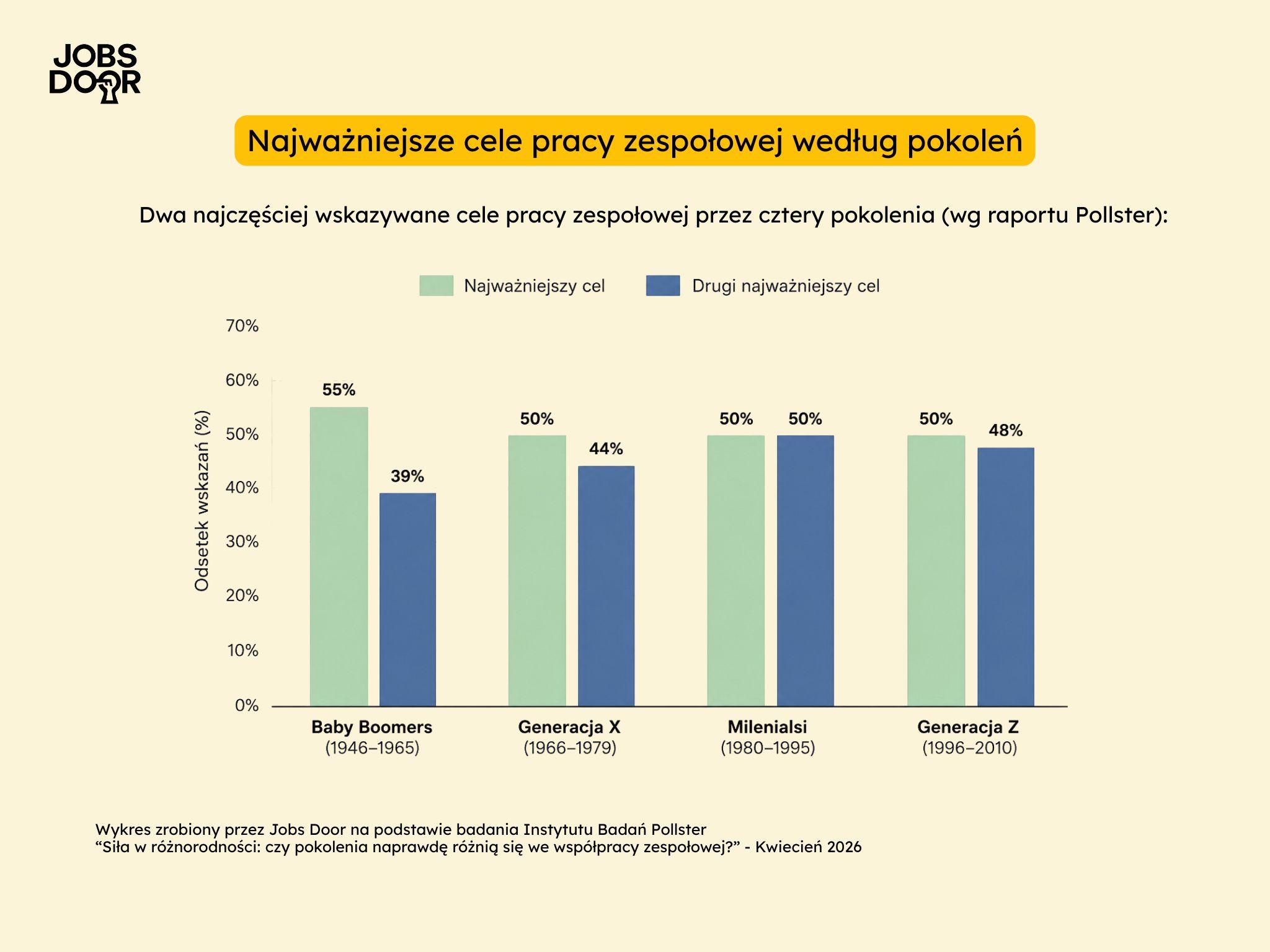
By far the most distinguished of all generations when it comes to leadership values is the youngest Generation Z. It was they who were the only ones who did not choose team integration as one of their most important values. Instead, she identified as the second most important goal the reduction of errors through mutual control — a value that none of the other generations chose so much. So you can see a certain distance forming especially between the oldest generation of Baby Boomers and the youngest Generation Z - although it is the latter that actually stands out a bit from all the rest. Does this mean that there are indeed profound differences between the workers of these generations? Not necessarily. Although at this stage of the report, when discussing the data on the perception of the objectives of teamwork, we can get this impression.
“I” in a team — that is, what do representatives of different generations value personally in teamwork and what is important to them?
The report states that despite the very factual and pragmatic approach of all generations to what teamwork is, values such as atmosphere and communication do not become less important than the effective execution of tasks that lead to the achievement of the team's goal. As the authors of the report point out, these values complement each other rather than contradict each other. In the case of preferences for what is most important in cooperation, we do not have so many intergenerational differences. By far the most important are the effectiveness of the entire team (49%) and a clear and fair division of tasks (47%). The third place is occupied by the friendly atmosphere and the absence of conflicts (42%), and the fourth place is the absence of chaos and good organization of work (39%).
As for the differences, the main rift appears again between the oldest and youngest generations. While Baby Boomers highly value the involvement of project participants (46%), Generation Z pays the least attention to this value (26%). The younger generation, on the other hand, is more likely to indicate the possibility of being listened to (25%) and feedback on their own contribution to the work (24%). Although these are not the most important of all eight values, compared to the results of Baby Boomers, it is clear that the younger generations care more about meeting individual needs. In comparison, only 10% of Baby Boomers indicated the opportunity to be heard, and only 11% indicated feedback about their own contribution to work.
Commenting on the report, experts point out that on the example of these two most distant generations, you can see a clear change of accents. In younger generations, the “I” and the need for individual attention play a greater role, while older generations are more likely to put the good of the team ahead of their own needs. But does this mean that the goals of the two groups contradict each other? Not necessarily. More than a conflict of values, it is probably about changing the way they are expressed and understood. As a result, what for some is a manifestation of commitment to the team, for others may simply be the need to be seen and heard - and these two perspectives do not necessarily have to be mutually exclusive.
Sources:
1. https://pollster.pl/files/reports/Raport-Sila-w-roznorodnosci-Pollster.pdf


 Polski (PL)
 English (EN)
 Español (ES)
 العربية (AR)
 Українська (UA)